Why Aren't We Warmer than the Last Interglacial?
If you look at graphs of global mean surface temperatures that go back to the last interglacial (LIG or the Eemian), you may notice that GMST anomalies were higher then than during the current interglacial (the Holocene), and current warming has not yet eclipsed the warmest periods of the Eemian. It's a fair question to ask, given that CO2 was ~280 ppm both during the Eemian and the Holocene (and over 420 ppm now), why aren't we yet warmer than the Eemian?

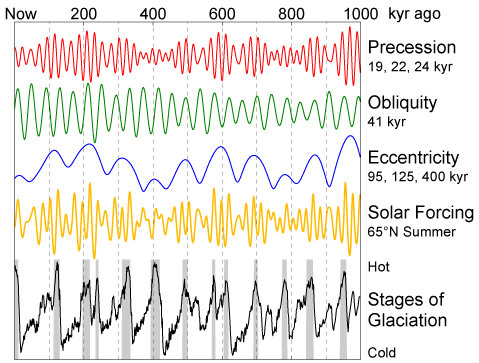
Long-term changes in GMST occur as a result of the energy imbalance near the top of the atmosphere, and on time scales of tens to hundreds of thousands of years, orbital cycles play a significant role in determining these GMST changes and the glacial cycles of the Quaternary. In fact, these have been synced with eccentricity (with a periodicity of 100K years) for the last 1 million years, but precession and obliquity also play a role in the variability of interglacial warmth. The combination of all three pushed the Eemian into a period of higher summer insolation, especially in the Northern Hemisphere. Greater summer temperatures lead to larger amounts of ice melting in the Arctic, which increases the amount of absorbed solar radiation, and this amplifies the warming signal from orbital cycles. So while CO2 during the Eemian was roughly the same as during the preindustrial Holocene, orbital forcings combined to make the Eemian warmer than the preindustrial Holocene.[1][2]
In fact, current research shows that the combination of all three orbital cycles largely determines the variability of glacial and interglacial periods over the last 900K years, and CO2, ice-albedo, and dust operate largely as feedbacks to orbital forcings. In another post, I show why geologists are convinced that perturbations of the carbon cycle explain most of the variability in global temperatures throughout the Phanerozoic, but CO2 is not the only external driver, and CO2 can also amplify the effects of other external drivers as a positive feedback. It's orbital forcings that explain why GMST was likely warmer during the Eemian than during the pre-industrial Holocene.
[3] Snyder, C. W. (2016). Evolution of global temperature over the past two million years. Nature, 538(7624), 226–228. doi:10.1038/nature19798. https://www.nature.com/articles/nature19798
 |
| Image from NASA |
In fact, current research shows that the combination of all three orbital cycles largely determines the variability of glacial and interglacial periods over the last 900K years, and CO2, ice-albedo, and dust operate largely as feedbacks to orbital forcings. In another post, I show why geologists are convinced that perturbations of the carbon cycle explain most of the variability in global temperatures throughout the Phanerozoic, but CO2 is not the only external driver, and CO2 can also amplify the effects of other external drivers as a positive feedback. It's orbital forcings that explain why GMST was likely warmer during the Eemian than during the pre-industrial Holocene.
However, humans have emitted about 750 GtC to the atmosphere since 1850, and that has increased CO2 concentrations to over 424 ppm. This has been a very large perturbation of the carbon cycle that has decoupled GMST changes from orbital cycles. In the absence of other forcings, orbital cycles would currently be pushing GMST towards slow cooling. However, instead of a very slow decent into the nest glacial period, the globe has warmed by over 1.1°C since 1970. And yet the best evidence we have indicates that we are not yet as warm as the Eemian.
To understand why this is the case, consider a simple analogy. If you take a pot of water and freeze it, then put the pot on a hot stove, the ice does not melt right way. While the burner and the air surrounding the pot are hot, it takes time for the ice to melt. The equilibrium state of the water lags the change in temperature. In the climate system, this lag can be hundreds of years, since only so much ice can melt annually, even given longer, hotter summers, and during winter it still gets cold enough for new snow and ice to form. In fact, there is good evidence that temperature has not yet caught up to current state of anthropogenic forcings (~3 W/m^2). Two points are relevant here:
- The globe has warmed 1.38°C in response to ~3 W/m^2 human forcings with an energy imbalance of ~1.4 W/m^2. With an ECS of 3°C, the equilibrium warming above preindustrial levels for current forcings will be substantially more than 1.38°C. We can estimate it as 3 W/m^2 *3°C/3.7 W/m^2 = 2.4°C, so we can expect perhaps another 1°C warming from current forcings. This alone would cause us either to reach peak Eemian warmth or exceed it in the next several decades. But this considers only the effects of rapid feedbacks to current forcings.
- Long-term feedbacks to forcings operate on time scales of hundreds to thousands of years. These include the retreat of ice sheets and the poleward movement of boreal forests (both of which decrease albedo and increase absorbed solar radiation). Scientists call this Earth System Sensitivity (ESS) and as a general rule, ESS ≈ 2*ECS.[3][4][5] This means that full equilibrium to current forcings over the next thousand years or so would be ~5°C, and this will push us well beyond anything the globe has seen during the Quaternary.
Graphs of GMST changes on time scales of hundreds of thousands of years show the effects of equilibrium warming after long-term feedbacks have already had their effect on global temperatures. It's premature to compare peek Eemian warmth to the warming of recent decades. EEI is still increasing, meaning that more warmth is built into current forcings, and the cryosphere is still shrinking, meaning that we can expect albedo to decrease and absorbed solar radiation to increase for hundreds of years into the future in response to current forcings. The evidence shows that even at current forcings, we have caused conditions that are putting climate on a trajectory that will bring us into conditions the planet has not seen in over 3 million years.
References:
[1] Stephen Barker et al., Distinct roles for precession, obliquity, and eccentricity in Pleistocene 100-kyr glacial cycles. Science387, eadp3491 (2025). DOI:10.1126/science.adp3491
[2] Fischer, N. and Jungclaus, J. H.: Effects of orbital forcing on atmosphere and ocean heat transports in Holocene and Eemian climate simulations with a comprehensive Earth system model, Clim. Past, 6, 155–168, https://doi.org/10.5194/cp-6-155-2010, 2010.
A comparison of the new temperature reconstruction with radiative forcing from greenhouse gases estimates an Earth system sensitivity of 9 degrees Celsius (range 7 to 13 degrees Celsius, 95 per cent credible interval) change in global average surface temperature per doubling of atmospheric carbon dioxide over millennium timescales. This result suggests that stabilization at today’s greenhouse gas levels may already commit Earth to an eventual total warming of 5 degrees Celsius (range 3 to 7 degrees Celsius, 95 per cent credible interval) over the next few millennia as ice sheets, vegetation and atmospheric dust continue to respond to global warming.
[4] The Cenozoic CO2 Proxy Integration Project (CenCO2PIP) Consortium, Toward a Cenozoic history of atmospheric CO2. Science 382,eadi5177(2023). DOI:10.1126/science.adi5177. Accepted version online at: https://oro.open.ac.uk/94676/1/Accepted_manuscript_combinepdf.pdf
The Cenozoic compilation confirms a strong link between CO2 and GMST across timescales from 500 kyr to tens of Myr, with ESS[CO2] generally within the range of 5-8°C – patterns consistent with most prior work, and considerably higher than the present-day ECS of ~3°C. Both temperature reconstructions imply relatively high ESS[CO2] values during the last 10 Myr of the Cenozoic, when global ice volumes were highest. This agrees with expectations of an amplified ESS[CO2] due to the ice-albedo feedback. However, even during times with little-to-no ice (Paleocene to early Eocene), we find elevated values of ESS[CO2] (approaching or exceeding 5°C per CO2 doubling).
[5] Emily J. Judd et al., A 485-million-year history of Earth’s surface temperature. Science 385,eadk3705 (2024).DOI:10.1126/science.adk3705
PhanDA provides a statistically robust estimate of GMST through the Phanerozoic. We find that Earth’s temperature has varied more dynamically than previously thought and that greenhouse climates were very warm. CO2 is the dominant driver of Phanerozoic climate, emphasizing the importance of this greenhouse gas in shaping Earth history. The consistency of apparent Earth system sensitivity (∼8°C) is surprising and deserves further investigation. More broadly, PhanDA provides critical context for the evolution of life on Earth, as well as present and future climate changes.


Comments
Post a Comment