Posts

Showing posts with the label AGW

On the Post-Relevance of RCP8.5

Image
A lot of misinformation has been circulating in recent weeks concerning the IPCC's decision to remove RCP8.5 from use in the upcoming AR7 report. I agree that the decision is a good one, and I think I can show why below with a simple toy model I created. I think it's fair to say that RCP8.5 is no longer a plausible future for us, given current emission reductions and the shrinking cost of renewable energy. For some very insightful comments from others about the death of RCP8.5, see Zeke Hausfather's post at Climate Brink  (also Michael Mann's comments on it here), a factcheck by Carbonbrief , Reto Knutti's comments , and the wonderful information at Climate Action Tracker . But the the usual suspects among contrarian political activists have been portraying the IPCC's decision as a win for "skeptics" and/or as an admission that the IPCC's projections have been fraudulent, such that over a decade of research that used RCP8.5 can now be safely disc...

Is there a Pause in the Decline of Arctic Sea Ice Extent?

Image
A couple papers were published this year about the recent "pause" in the decrease in September sea ice extent (SIE). One paper, Stern 2025 [1] shows that the trend in Sept. SIE has been indistinguishable from 0 since about 2007.  From Stern 2025 Likewise, England et al 2025 [2] has found that 20-year trends have increased to the point where there is no longer a statistically significant downward trend for 2005-2024. England et al 2025 The publication of these two studies, plus coverage of at least the latter in the Guardian , has caused quite a stir among contrarians on social media, who are claiming this is evidence that AGW isn't really a problem after all, and perhaps natural variability is what's driving recent changes in sea ice extent and temperature. However, that's not the way the authors of these studies are saying. Instead, the authors see the long-term downward trend in sea ice as being very real and caused by human activity, but they are also saying ...

Emergence of Climate Impact Factors in IPCC Assessments

Image
There is a table floating around X and other social media outlets being used to claim that even the IPCC acknowledges that most extreme weather events are not increasing in frequency or severity. This claim comes from a misreading of Table 12.12 in the AR6 report from the IPCC. The line of reasoning comes almost entirely from this chart, and in the past, I've responded to several people making these claims by quoting from the text of AR6 to clarify what it says about some of these climate impact drivers (CIDs). But Tim Osborn put together a series of posts on X that does a better job of explaining how badly these people are misreading the chart. Following extended arguments on X is sometimes difficult, especially for those who (like me) don't pay to be able to make longer posts. So I thought it would be helpful to reproduce his argument here in a manner that is more easy to digest without the need to scroll through several posts and hope you're keeping them in order. I wan...

Happer Contradicts Himself on Climate Sensitivity

Image
W. A. van Wijngaarden and William Happer (WH) have periodically attempted to circumvent publishing manuscripts in peer-reviewed journals and have instead taken to uploading manuscripts on the arXiv. As I understand it, the intended use for the arXiv is to allow pre-published manuscripts to be read and evaluated by scientists before the peer-review process is completed. This gives scientists faster access to the newest research, but with the caveat that these manuscripts may need to be revised significantly before being published, once going through the peer review process. Some may not even be published at all, so scientists often look at these manuscripts with interest but also with a grain of salt until the final version passes peer review. WH are apparently using the arXiv to store manuscripts for which they have no intention of submitting to any peer-reviewed journal. The manuscripts are formatted to look like scientific papers, but they will never see the light of day in an ac...

Is Patrick Brown Right that the Most Prestigious Journals are Biased?

Image
Patrick Brown recently published a blogpost in which he suggested that in order to get published in highly prestigious journals, you have to follow a "not-so secret" formula. Another version of this shows up in the Free Press . According to Brown, "the formula is more about shaping your research in specific ways to support pre-approved narratives than it is about generating useful knowledge for society." Now I want to be clear about a few things before I get into this. First, it appears he's not attacking peer-reviewed journals in general or even highly respected journals a tier below the top echelon of Nature and Science . It also doesn't appear that he thinks these journals are forcing a narrative that isn't true; only that they are preferentially selecting the negative aspects of AGW over others factors, and science would benefit if these journals published more useful and comprehensive analyses. And he also seems to acknowledge that the kinds of mo...

Does Cold Weather Kill More than Hot Weather?

Image
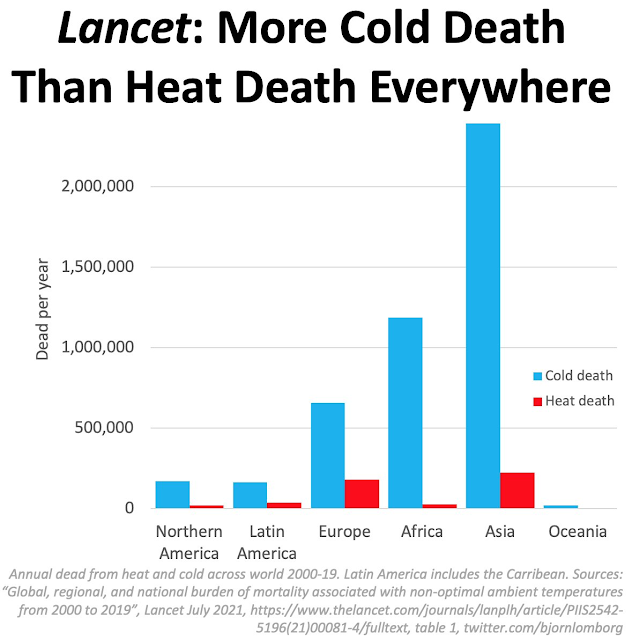
If you follow contrarian talking points on social media, you might get the impression that cold weather kills more people than hot weather, and so global warming will result in fewer deaths, and lives will be saved as the planet warms. You can see this in this graph from Bjorn Lomborg, based on a Lancet study[1] that quantifies "cold-related" and "heat-related" deaths. This kind of thinking may seem superficially convincing, but with a little investigation, much of what is being said by Lomborg (and others) is incredibly misleading. It's based on a misunderstanding of what these types of studies say, as well as some flawed logic about how deaths will be affected by warming.  Cold vs Hot Related Deaths This Lancet paper is one of many[2][3] based on a concept of "minimum mortality temperature" (MMT), which is defined as the mean temperature at which non-accidental death rates in any particular location is the lowest.  In most places the mortality rate i...