Posts

Showing posts with the label CMIP6

John Christy's Misleading Graphs from 2016

Image
It's been over a decade, but occasionally I still see people sharing the graphs John Christy's presented as testimony in 2016 as "evidence" that models can't accurately predict observations. The graphs have been heavily criticized at RealClimate (see  here  and here ) for very good reasons.  Sometimes these graphs get dressed up with a different aesthetic while keeping the comparison exactly the same. The version below is from a Heritage Foundation "report" published in April of 2026, but the authors didn't even bother to update observations to 2025. They just ignore the last 10 years of observations, possibly because none of the authors had the competency to update the observational data to today. Since Benestad  and Schmidt  have done such a thorough job debunking these types of graphs, I don't see any need to duplicate their efforts, but here's a brief summary of the what's misleading about these graphs: Christy chose comparisons of a...

2024 Global Mean Surface Temperature

Image
Most of the GMST temperature data is in for 2024, and as most predicted, it was the warmest year on record, though perhaps by a larger margin than expected. El Niño conditions developed in 2023, and typically the following year becomes the warmest year on record. When large El Niños developed in 1997 and 2015, it was the following year that became record years, and this pattern continued again.  Above, here's how 2024 looks in several major datasets. I put the 2-sigma uncertainties for HadCRUT5 in dotted lines. This graph is set to the 1951-1980 mean (left scale), and this allows you to see that most of the variability between the datasets occurs in the late 19th century. The right scale is offset to show the warming above the 1850-1900 baseline for HadCRUT5 with the 1.5°C target as a dotted horizontal line. Below I set the same data to the 1850-1900 baseline and plotted centered 30-year means from HadCRUT5; this has the effect of better showing warming for each dataset above ...

Responding to the CO2 Coalition's "Fact #21" on Climate Models

Image
CO2 Coalition 's " Fact #21 " claims that "IPCC models have overstated warming by up to three time too much." According to this claim to fact, John Christy's testimony on "February 2016 to the U.S. House Committee on Science, Space & Technology included remarkable charts that document just how much the models overestimate temperatures. The red line in the chart shows the average of 102 climate model runs completed by Christy and his team at the University of Alabama at Huntsville using the models on which the IPCC itself relies. Also shown on the chart are the actual, observed temperatures. The models exaggerate warming, on average, two and a half times the actual temperature (or three times over in the climate-crucial tropics). Here's the graph they use to support this claim. The above graph reports to show 32 models and 102 model runs within the CMIP5 model ensemble. They are limited to those runs in the KNMI Climate Explorer. The models are s...

Human Activity Has Likely Caused Virtually All the Warming since the Late 19th Century

Image
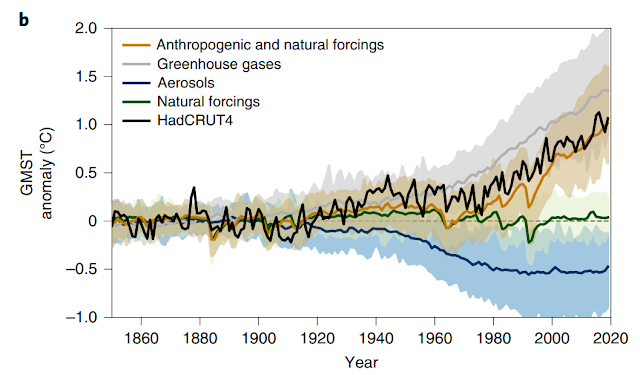
The IPCC AR5 estimates that human activity is responsible for ~110% of the warming since 1951. This statement may seem far fetched to some, but a new paper from Gillett suggests that this actually may be a bit conservative. Gillett's work extends that analysis back to the latter half of the 19th century. The study concluded that "anthropogenic forcings caused 0.9 to 1.3 °C of warming in global mean near-surface air temperature in 2010–2019 relative to 1850–1900, compared with an observed warming of 1.1 °C. Greenhouse gases and aerosols contributed changes of 1.2 to 1.9 °C and −0.7 to −0.1 °C, respectively, and natural forcings contributed negligibly." In the above graph, you can see the that the impact of GHG and aerosol forcings dwarf the impact of other natural forcings. ' Observant readers may note that there are two relatively short-term temperature spikes in the instrumental record, one during the 1860s and another during the 1940s. But these warm years cooled ag...