Posts

Showing posts with the label tsi

It's not the Sun

Image
The graph above shows annual values and 11-year running means for TSI[1] and GMST anomalies[2] from HadCRUT5. It's very clear that 11-year running means for TSI have varied by very little. The brightest years differ from the dimmest years by only about 0.5 W/m^2, and some of the dimmest years have begun after 2010. However, GMST began to warm around 1910, and after a brief pause from 1940-1970, GMST has increased by an an average of 0.2°C/decade. There is not much evidence for correlation in this graph. If I plot both so that they are similar from 1850 to 1910, they part ways a little after 1910 and then diverge in trend after about 1960. Of course, you could argue that I've chosen a scale for TSI to exaggerate the differences, though this could only potentially be true from 1910-1960, but we can get past this objection by plotting annual TSI values on the x-axis and annual GMST anomalies on the y-axis. Here it's clear that annual TSI is a terrible predictor of GMST anomali...

Can Bray and Eddy Cycles Explain Global Warming?

Image
There's a  schematic  that is frequently promoted by John Shewchuk on X to claim thatt long-term solar cycles explain much more of temperature variability of the last 2000 years than changes in greenhouse gases like CO2. The implication is also frequently made that the current warming over the last century or so is due to these cycles and not to changes in GHG concentrations. One common version of this graph is here. The Hallstatt-Bray cycle, which has a periodicity of ~2400 years, and the Eddy cycle, which has a periodicity of 976 years, are both related to sunspots, and so they indeed do have an impact on total solar irradiance (TSI), and therefore they can in principle have an effect on global temperatures on millennial timescales. But the significant question is, by how much?  Astute observers will note that Shewchuk didn't include any scale for the y-axis; the impact of these cycles could be negligible or large as far as this schematic is concerned. I do find ironic,...

Is the Sun Responsible for Recent Warming?

Image
In a previous post , I pointed out that I find the notion of quantifying "consensus" to have limited value, but one value I admit it can have is to show areas of climate science about which practicing scientists no longer in actively debate in the literature. This allows us to understand what debates in popular discourse do not translate into debate among climate scientists. One of the most common objections to AGW I hear in popular circles is that warming is caused by the Sun, rather than human activity. The most common way I see this claim is with reference to solar variability in terms of total solar irradiance (TSI). Variability in TSI can be caused by two things: changes in solar output, like the 11-year solar cycle, or changes in the distance between the earth and the Sun. Variability in the Earth's orbit around the Sun, often referred to as orbital cycles, do not change the total amount of energy the Earth receives in a year, but they can change the distribution of...

Is There an Ongoing Debate about the Impact of Solar Variability on Climate?

Image
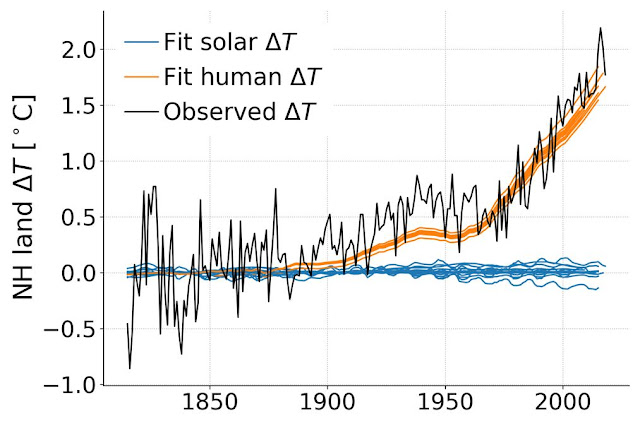
This is part 1 of  review of the claims in Connolly et al 2021. You can see part 2 here . A paper was published in 2021 arguing that scientists have been premature to rule out the possibility that the Sun is the dominant explanation for the current warming trend. One key element in this argument is that there is continued disagreement over the degree of solar variability in reconstructions of Total Solar Irradiance (TSI) since 1610.  Some reconstructions show "low solar variability," and if those are correct, then current warming may be best explained by anthropogenic forcings. However, if "high solar variability" reconstructions are correct, then solar variability may explain most of current warming. So Connolly et al argue that "the answer to our question 'How much has the Sun influenced Northern Hemisphere temperature trends?' depends substantially on which estimate of TSI we choose."[1] But is this correct? Connolly et al Figure 2 Figure 2 in h...