Posts

Showing posts with the label feedbacks

How Feedbacks Amplify Global Warming

Image
In a previous post (see that post for the cited literature), I calculated ECS from data provided in the Indicators of Global Climate Change for 2025 (IGCC25). I made 4 calculations using ΔT from two different baselines (1850-1900 and 1790-1839) and two different means for current temperature (the last 4 years and the last 12 years). I’d like to share again the calculations using a 1850-1900 baseline so I can illustrate how feedbacks amplify a warming signal. Here are the calculations in table form: Where ΔFt is total forcings since 1850 and ΔFc is the forcing for doubling CO2. Using these values and the Energy Balance Equation and averaging the two results, we come up with an ECS of 3.4°C. Notice here that to calculate ECS we didn’t have to quantify any feedbacks. We do know that there must be positive feedbacks because Planck sensitivity (Sp) is only about 1.2°C, and we’ve already seen that much warming with just over a 50% increase in CO₂. But the Planck Feedback (λp) is important ...
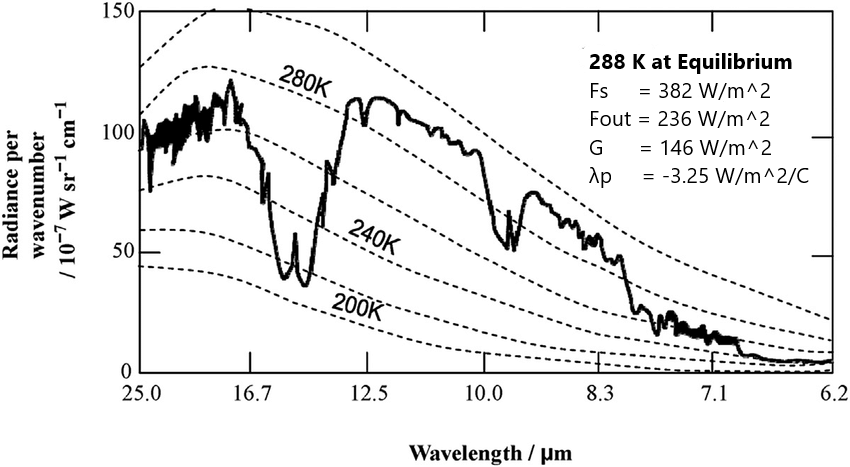
The Physics of the Climate Response to Doubling CO2

Image
Update (8/2026):  I update the numbers here to account for the updated value of 3.93  W/m² for 2xCO2 ( AR6). The Earth's effective temperature - the mean surface temperature of Earth if the atmosphere contained no GHGs but with current albedo can be calculated since we know that ASR (hereafter Fin) =  (1-α)*S/4 and OLR (hereafter Fout) is governed by  εσ*T^4. At equilibrium, ASR = OLR (Fin = Fout). With no greenhouse effect (GHE), the Earth's emission temperature (Te) would be at the surface, meaning that Te = Ts, so we can solve for Te with ASR = OLR (1-α)*S/4 = εσ*Te⁴ If we solve for Te with a surface emissivity ( ε) o f 0.98 and albedo ( α) of 0.306, we end up with Te = 255.3 K.  So, if the earth had no atmosphere with albedo roughly the same as today, the average surface temperature of the earth would be about  -18°C.  However, we know that currently, the earth is about 33°C warmer than this; it's ~288 K or 15°C. The ~33°C difference is c...